Deep learning researcher · PhD, Technion (2026)

I study what deep models actually compute, and how to build physical and physiological structure into them.

My recent work builds calibrated diagnostics for language models: effective depth, the shuffle gap and invertible query-key coupling, with two first-author papers at ACML 2026. Alongside, I keep classical structure inside the learning loop: a differentiable Randers-Finsler eikonal solver for wildfire spread (SGP 2026, Computer Graphics Forum) and physiologically constrained models that estimate VO₂ from smartwatches and from 3D human pose in video (ACM ICMI 2025, Apple). PhD advised by Alex Bronstein and Reuven Cohen.

Open to research scientist and applied scientist roles in LLM understanding, physics-informed AI and sensing.
Barak Gahtan
2 × ACML 2026First-author papers on LLM depth and attentionSGP 2026Differentiable eikonal solvers, Computer Graphics ForumICMI 2025 · oralFirst instantaneous VO₂ from a consumer smartwatchTechnion · ApplePhD in Computer Science; research contractor, Video Engineering

Selected work

All 13 publications
ACML 2026 · PMLR

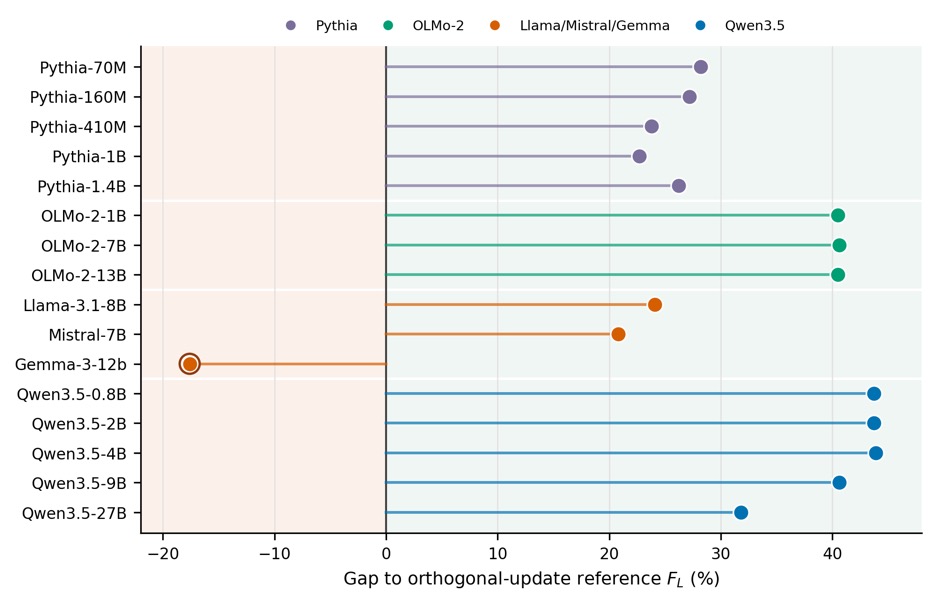
The Residual Stream's Effective Depth

Barak Gahtan, Ido Galil, Alex M. Bronstein

A calibrated scalar for how much of a transformer's depth is distinct computation: fifteen of sixteen decoder-only models fall below the orthogonal-update reference, and matched controls trace the gap to correlated residual updates.

Computer Graphics Forum · SGP 2026

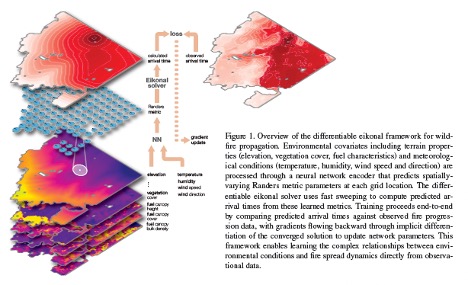
Differentiable Randers-Finsler Eikonal Solvers

Barak Gahtan, Jacob Shpund, Alex M. Bronstein

A GPU fast-sweeping solver made exactly differentiable through implicit differentiation, used to recover anisotropic metrics from sparse arrival times and learn spread models on real wildfire perimeters.

Research themes

  • What transformers actually compute

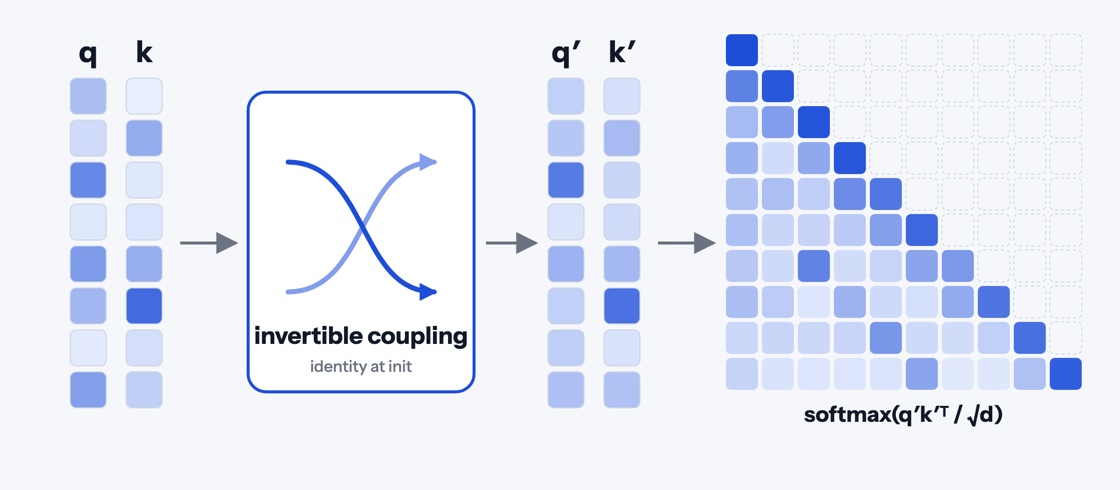
    Calibration-free diagnostics that audit a model instead of trusting its headline scores: how much of its depth is distinct computation, whether a personalized model conditions on the user at all, and where pre-scoring query-key geometry helps attention.

  • Differentiable physics and inverse problems

    Classical solvers kept inside the learning loop. Implicit differentiation through fast sweeping turns anisotropic Eikonal distance fields into trainable models of wildfire spread.

  • Physiology from low-friction signals

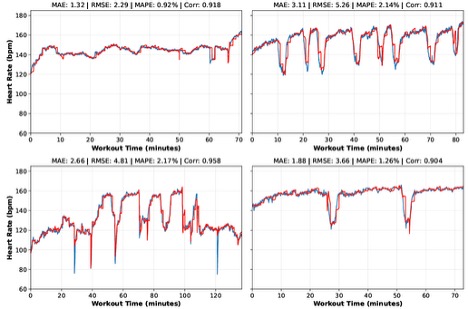
    Instantaneous VO₂ and cardiovascular load estimated from smartwatches, chest straps and monocular 3D pose in video, with neural ODE and Kalman structure and four datasets collected in the field.

  • Encrypted network traffic as time series

    QUIC traces rendered as image sequences and multi-operator cellular links as multivariate series, from a 100,000-trace public dataset to real-time network selection for teleoperated vehicles.